

Women and Work- Demands That Echoed Through July 2026
News, research and data about women and work - curated by our team

Hello, and welcome to CEDA’s newsletter ‘Women & Work’!

Some of the most important stories this month were not about what changed, but about who refused to give up. Lakhs of young Indians demanded accountability after yet another exam paper leak threatened to reduce years of effort to chance. In Madhya Pradesh, tribal women continued their fight against displacement under the Ken-Betwa river-linking project, refusing to let decisions about their land, livelihoods, and futures be made without them. Their struggles are different in form but united in purpose. They remind us that fairness is not something societies achieve once and for all. It is something that must be defended every time institutions fall short and every time unequal outcomes are accepted as normal. The gaps we document in women's work, whether in participation, pay, entrepreneurship, or recognition, are no different. They persist not because we fail to see them, but because seeing them is only the first step. Evidence gives us clarity; action gives it meaning. This edition is part of that continuing pursuit.
Before we get started, a request: We are curating ‘Women & Work’ with the hope that it can provoke, stimulate and amplify conversations about women’s participation in paid work in India. If you like this edition, please do share it on your social media, and with your friends, family and colleagues. Thank you.
In case you would like to read any of our past editions, they are available here.

🗞️ In The News
Are India’s biggest cities engines of women’s employment, just as they are engines of economic growth? In this opinion piece, Dr. Kanika Mahajan, Associate Professor of Economics at Ashoka University, argues that while women in million-plus cities are more likely to hold regular salaried jobs, too few are in the workforce to begin with, and those who are continue to face sizeable pay gaps. Thus, making cities work for women requires tackling barriers that go well beyond childcare, including mobility, safety and workplace advancement.
Maharashtra has become the first Indian state to enact a law formally recognising women as farmers, regardless of land ownership. The Maharashtra Women Farmers Empowerment Act, 2026, enables eligible women engaged in agriculture and allied activities to obtain a women farmer certificate, giving them access to government schemes, institutional credit, crop insurance, and extension services. Read more here.
The recently released NFHS-6 factsheet reports revised estimates of women’s land and house ownership for both NFHS-6 and NFHS-5, using data from the Household Questionnaire (HQ) instead of the Women’s Questionnaire (WQ). The change follows a growing body of research questioning the reliability of WQ-based estimates, including the work of Dr. Bina Agarwal and Dr. Christophe Guilmoto, whose 2023 research highlighted that WQ-based estimates displayed implausibly high ownership levels, inconsistent regional patterns, and diverged from other nationally representative datasets, while HQ-based estimates provided a more credible basis for measuring ownership.

💡 Research Spotlight
The United Kingdom’s workforce is shaped by people from diverse ethnic backgrounds. While women from many ethnic communities participate in the labour market, their rates of participation differ markedly across ethnic groups. According to Understanding Society, one of the UK’s largest longitudinal household surveys, labour force participation ranges from 91% among Caribbean women to 52% among Pakistani women, with Bangladeshi women (54%), Indian women (81%), and White British women (88%) falling in between. These striking differences have been widely documented, but an important question remains unanswered: What explains them? Are they primarily about education, family responsibilities, cultural norms, or do other barriers stand in the way? These are the questions at the heart of a recent study by Cigdem Gedikli, Gurleen Popli and Okan Yilmaz, published in Oxford Economic Papers.
📝 About the study
Labour force participation captures whether a person is employed or actively looking for work. If women are not participating in the labour market, wage comparisons tell only part of the story. Understanding why some women enter paid work while others do not is therefore the first step towards understanding broader labour market inequalities. Using data from Understanding Society, drawing on Waves 2 (2010-12), 4 (2012-14), and 10 (2018-20), the researchers analyse 18,379 women aged 16-65 across six ethnic groups, comparing Indian, Pakistani, Bangladeshi, Caribbean, and Other Black women with White British women. The researchers examine six broad sets of factors: human capital (such as education and age), integration (including English language proficiency and age at migration), household composition (for example, having young children or a partner), household resources, gender norms, and family background, including whether respondents grew up with a working mother. By accounting for these characteristics, the study estimates how much each factor contributes to the observed differences in labour force participation across ethnic groups.
📋 Methodology
The researchers first estimate the raw (or unconditional) differences in labour force participation between each ethnic group and White British women. They then estimate conditional gaps by controlling for the six factors. One of the study’s most notable methodological contributions is that it does not treat culture or gender norms as unobserved explanations. Instead, it directly measures attitudes using a survey-based index constructed from respondents’ views on gender roles.
The research uses Gelbach decomposition, a statistical technique that attributes the explained portion of the employment gap to different groups of characteristics. Unlike traditional stepwise regression approaches, Gelbach decomposition produces estimates that are not affected by the order in which variables are introduced into the model.
🔍 Findings
For Indian women, the initial participation gap relative to White British women is 7.1 percentage points. Once observed characteristics are accounted for, the gap becomes statistically insignificant, leaving a total explained gap of 8.2 percentage points. Integration, particularly age at arrival, is the largest contributor, accounting for 55% of the explained gap. Household composition, chiefly the presence of children, explains a further 27%, while gender norms account for 25%. Having had a working mother contributes an additional 11%, highlighting a notable intergenerational effect. These positive contributions are partly offset by two negative factors: household resources (−2%) and birth cohort (−10%). Indian women also have somewhat higher levels of education than White British women on average, which would work against rather than explain the gap. However, this human capital contribution (−5%) is not statistically significant in the decomposition.
For Pakistani women, the unconditional gap is much larger, at 36 percentage points, falling to 14.6 percentage points once observed characteristics are accounted for. Integration accounts for 34% of the explained gap, household composition for 29%, gender norms for 23%, and human capital for 16%. Bangladeshi women show a similar pattern: an unconditional gap of 33.6 percentage points falls to 11.6 percentage points once observed characteristics are accounted for. Integration (34%), household composition (30%), gender norms (18%), and human capital (20%) are the main contributors.
For Caribbean women, labour force participation exceeds that of White British women. The study finds that more egalitarian gender attitudes and higher educational attainment contribute positively to their labour force participation, while migration-related factors reduce it. After accounting for all observed characteristics, Caribbean women remain more likely than White British women to participate in the labour market.
Across all ethnic groups, more traditional gender attitudes are associated with lower labour force participation. This relationship is particularly interesting because it varies with household income. The negative association between traditional gender norms and employment is stronger among higher-income households, suggesting that when families are less financially constrained, social norms have a greater influence over women’s decisions to participate in paid work.
Not all differences can be accounted for by the observed characteristics included in the survey. The study does not interpret this residual gap as evidence of discrimination. Rather, it emphasises that the unexplained component captures all factors not measured in the data. These may include employer discrimination, differences in local labour market opportunities, social networks, or other unobserved barriers that are not captured by the survey.
📌 Why the Findings Matter
The study demonstrates that there is no single explanation for ethnic differences in women’s labour force participation. Education matters, but so do migration histories, household responsibilities, language proficiency, and gender norms. More importantly, the relative importance of these factors varies across communities.
The findings suggest that policies aimed at increasing women’s employment should move beyond one-size-fits-all solutions. Language and integration support, childcare, flexible work arrangements, and interventions that challenge restrictive gender norms are all likely to matter, but not equally across all groups. Understanding why employment gaps exist is therefore just as important as measuring how large they are.
📊 Datapoint
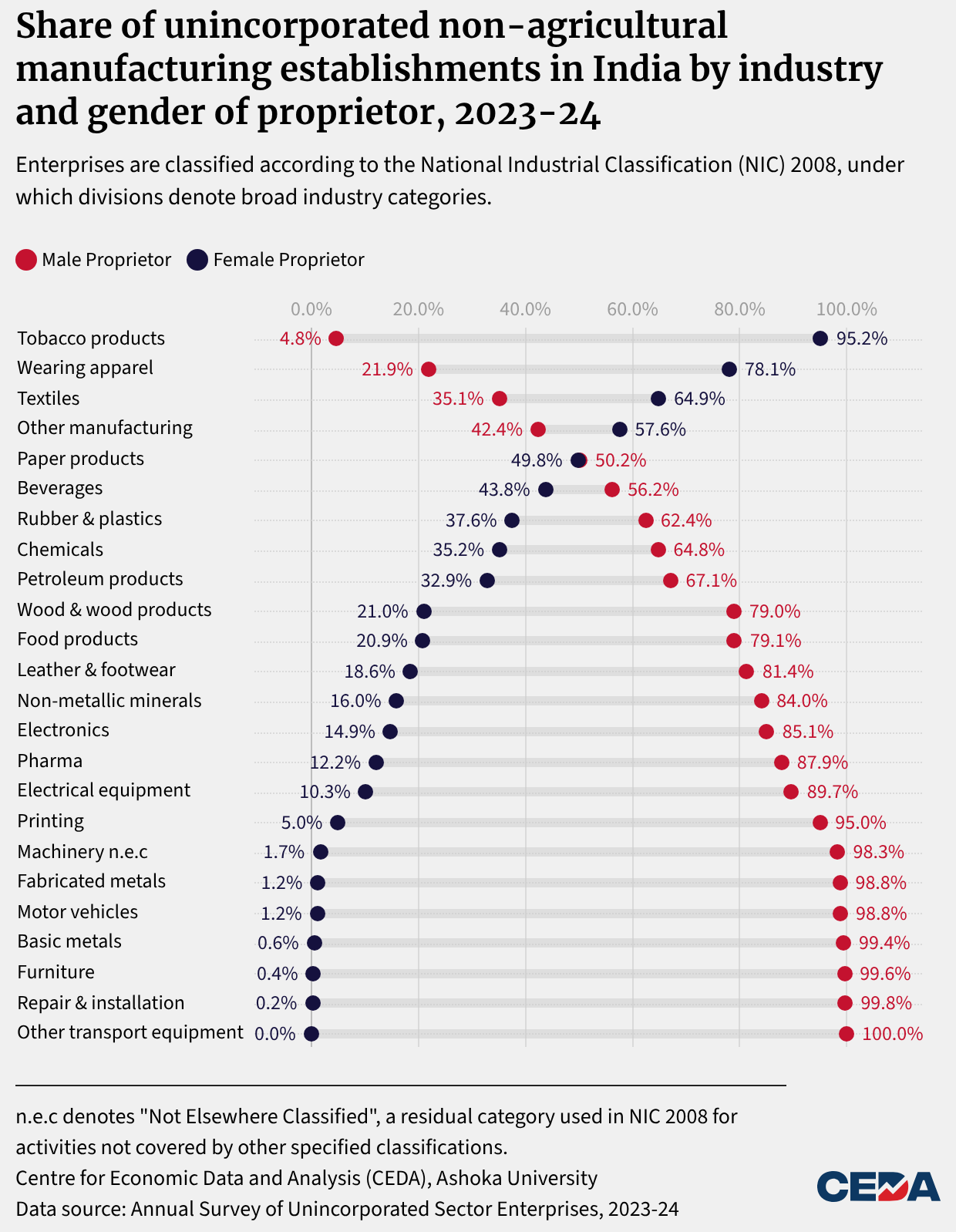
The Annual Survey of Unincorporated Sector Enterprises (ASUSE) provides nationally representative data on India’s non-agricultural informal sector, covering unincorporated enterprises engaged in manufacturing, trade, and services. According to ASUSE 2023-24, women own nearly six in ten enterprises in India’s informal manufacturing sector, challenging the notion that manufacturing is a man’s domain. But as with many headline statistics, the real story lies beneath the surface. Women’s ownership is concentrated in just four industries: tobacco products, wearing apparel, textiles, and other manufacturing. In much of the rest of the manufacturing landscape, from machinery and fabricated metals to motor vehicles and printing, enterprise ownership remains firmly in men’s hands. What appears to be broad-based representation is, in reality, a story of concentration in a handful of industries.
Behind every enterprise is a story of opportunity, choice, and constraint. CEDA’s latest analysis goes beyond ownership shares to examine where women entrepreneurs are concentrated and what these patterns reveal about the realities of women’s entrepreneurship in India’s informal manufacturing sector. Read the full analysis here.
⏳ Throwback
When Equality Made Women Wait
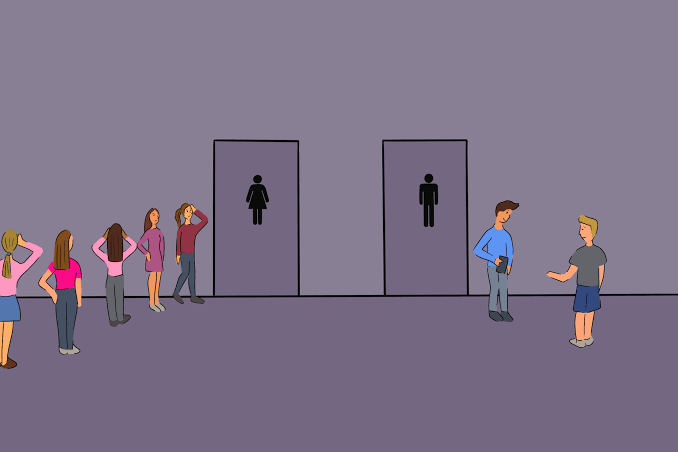
There is a familiar ritual at almost every airport, theatre, stadium, or concert venue. As soon as a break, intermission, or boarding call sends people moving, crowds make a beeline for the restrooms. Minutes later, the men’s queue has vanished, while the women’s queue continues to wind through the corridor. Many women instinctively plan for it, leaving their seats a little earlier or budgeting extra time before boarding a flight. The queue feels inevitable, almost natural. But what if it isn’t?
For much of the twentieth century, architects and planners approached public restrooms with a simple principle in mind: equality meant providing men and women with roughly the same amount of space. On paper, it seemed fair. Equal square footage, equal budgets, equal treatment. Yet identical design produced very different experiences. Unlike men’s restrooms, which typically combine cubicles with urinals, women’s facilities rely entirely on cubicles. Women also spend more time in restrooms. Menstruation, pregnancy, and menopause are part of the explanation, but so is care work. Women are far more likely to accompany young children, assist older relatives, or help family members with disabilities. The restroom is often not just for themselves, but for someone else too. The result is a paradox: equal provision can create unequal access.
This insight gave rise to the idea of potty parity, a movement that challenged the assumption that fairness meant identical numbers of toilets or equal floor space. Instead, it proposed a different measure of equality: waiting time. If women consistently spend twice as long in line, can a design really be described as equal? The question may seem oddly specific, but it transformed how planners began thinking about public infrastructure. The queue outside the women’s restroom became evidence of something much larger: public spaces are never truly neutral.
Every design decision reflects assumptions about who will use a space, how they will move through it, and whose time is valued. For decades, the ‘average user’ imagined by planners was someone travelling alone, moving efficiently between home and work, unconstrained by caregiving responsibilities or concerns about safety. Yet many women’s journeys rarely look like this. They combine commuting with school drop-offs, grocery shopping, caring for family members, and navigating public spaces that often feel less accessible and less secure. Infrastructure designed for one pattern of life inevitably works less well for another. The lesson extends far beyond toilets. It reminds us that equality is not always achieved by treating everyone the same. Sometimes, designing fairly means recognising that different people interact with public spaces in different ways.
The next time you find yourself standing in a seemingly endless line outside the women’s restroom, it is worth asking a different question. Perhaps the queue is not a failure of efficiency, but a reminder that the way we measure fairness matters. Sometimes, the longest queue in the building tells us the most about how our cities were designed and who they were designed for.
📽️ Lights, Camera, Hustle: Women’s Work Lives in Movies
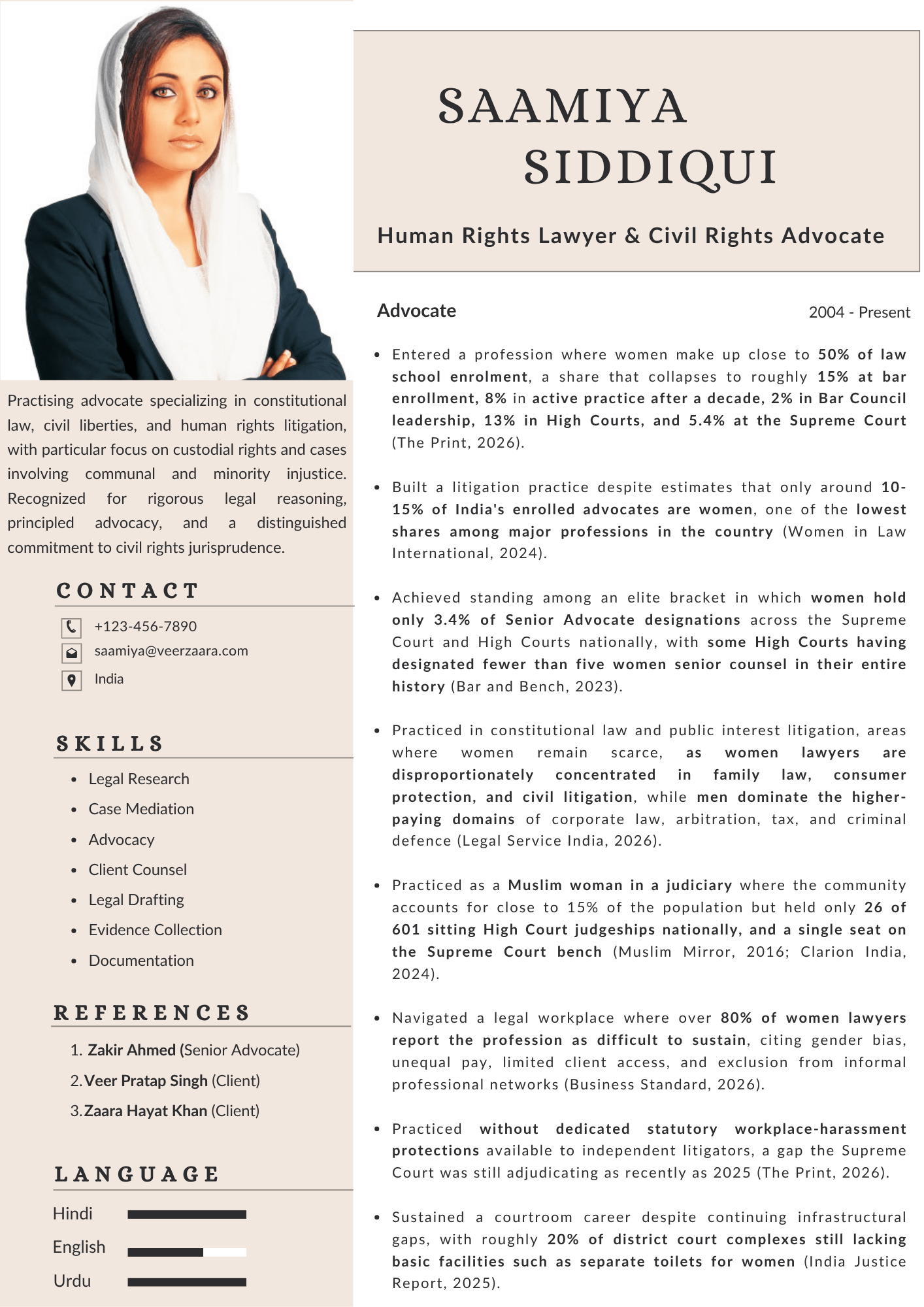
This fictional CV is a creative work inspired by the character Saamiya Siddiqui from Veer-Zaara (2004), with all names and references respectfully credited to the film’s original creators and rights holders.
Thank you for reading! If you have feedback, questions, tips, or just want to say hello, feel free to do so by replying to this email, or drop a word at editorial.ceda@ashoka.edu.in
For more updates and conversations, be sure to follow us on LinkedIn and X. We look forward to staying connected with you!
Curated by: Sneha Mariam Thomas for the Centre for Economic Data & Analysis (CEDA), Ashoka University. Cover illustration: Nithya Subramanian
One number worth adding to the July picture: in Indian tech GCCs the gender pay gap is not a hiring gap, it is a compounding one. It starts near 4% at entry and widens to about 16% at senior (TeamLease Digital, 2026). Nobody ever cuts her salary. Equal percent raises on a smaller base, a break that resets her pay lower, and one in three women never asking for a raise vs one in five men (Naukri, 2026) stack across 15 years. Headcount improved, women went from 31% to 38% of GCCs since 2020, while pay at the top did not. The fix is not a diversity drive. It is resetting your pay to the market rate for the new level at every promotion or return. Which moves that senior 16% faster: pay transparency, or fixing the re-entry reset?
Zia. AI career strategist for Indian professionals. itszia.ai