

Women and Work- Echoes Emerging in March 2026
News, research and data about women and work - curated by our team

Hello, and welcome to CEDA’s newsletter ‘Women & Work’!

March bursts onto the scene with celebratory fervor. Around International Women’s Day, timelines overflow with tributes, panels, and grand promises of empowerment. But beyond the purple banners and eloquent pledges lurks a stark question: what does support for women’s work truly mean the other 11 months and 30 days? At Women and Work, we cut through the fanfare to scrutinize the structures shaping women’s economic realities: who gets hired, who rises, whose labour counts, whose stays brutally invisible. Dr. Ashwini Deshpande, Academic Director of CEDA, lays bare the hypocrisy in her powerful piece, from Gisele Pelicot’s trial to Epstein’s files, no society escapes complicity when patriarchal norms shield sexual violence that erases women’s voices. This month, we dive into India’s economic data on women’s participation, mapping expansions amid persistent gaps. Fleeting nods won’t cut it; enduring change demands policies, workplaces, and systems fueling women’s work year-round.
Before we get started, a request: We are curating ‘Women & Work’ with the hope that it can provoke, stimulate and amplify conversations about women’s participation in paid work in India. If you like this edition, please do share it on your social media, and with your friends, family and colleagues. Thank you.
In case you would like to read any of our past editions, they are available here.

🗞️ In The News
In a landmark ruling, the Supreme Court of India noted that women effectively work longer hours than men when unpaid care and domestic labour are accounted for, citing global evidence, and used this to extend maternity benefits to all adoptive mothers regardless of the child’s age. The Court recognised that caregiving demands remain similar across forms of motherhood, underscored the economic invisibility of women’s unpaid work, called for paternity leave policies, and highlighted the persistent challenge of balancing caregiving with workforce equality. Read more here.
In a separate decision, the Supreme Court rejected a plea for mandatory menstrual leave, cautioning that such a mandate could unintentionally deter employers from hiring women and reinforce workplace bias, while noting that policy decisions of this nature fall within the government’s domain. While the Court acknowledged menstrual health concerns and the need for thoughtful policy design, the ruling also leaves a gap in formal workplace support, underscoring an unresolved tension between ensuring equality in employment and addressing gender-specific needs. Read more here.
A recent white paper by the Centre for Finance & Economics Research (CFER) at the Great Lakes Institute of Management, based on Time Use Survey 2024 data, highlights a stark gender gap in youth employment in India: only 18% of women aged 20-29 are in paid work compared to 79% of men, despite near parity in education. The report also shows that employed young women work over 90 minutes more per day than men when unpaid care is included, underscoring the dual burden shaping women’s labour market outcomes. Read more here.

💡 Research Spotlight
👩👧👦The village that sustains work and the city that doesn’t
Here’s a statistic that should make us stop and rethink everything we assume about women and work in India: A rural mother is nearly twice as likely to be employed as an urban mother, ~32% vs ~17%. This isn’t a small gap; it’s a structural fault line. Because if cities offer better jobs, higher wages, and more opportunities, why are they where mothers are least likely to work?
Leila Gautham’s 2022 study answers this with a sharp, data-backed insight: it’s not the burden of care that pushes women out of work, it’s whether work can accommodate that care. Instead of asking why women don’t work, this study asks: What is it about jobs and childcare systems that makes work possible in some places and impossible in others? It moves the conversation from individual “choices” to structural constraints, using time-use data to show how everyday realities shape labour force participation.
What the Study Does
Using the Indian Time Use Survey (2019) alongside labour-force and demographic data, it undertakes:
Time-use analysis to quantify childcare and unpaid domestic work
Rural-urban comparisons of maternal employment rates
Regression models estimating the motherhood penalty, controlling for education, income, and demographics
Evaluation of childcare infrastructure effects on employment
Findings
Care burdens are high, gendered, and not the source of the rural–urban employment gap: Women spend ~299 minutes/day on unpaid domestic work vs ~97 minutes for men, and mothers perform ~4x more childcare than fathers across both rural and urban India. Importantly, childcare time is nearly identical across rural and urban mothers, establishing that differences in employment cannot be explained by lower caregiving burdens in rural areas.
Work structure and the ability to “co-locate” care drives employment outcomes: Rural women are concentrated in informal, home-based, or proximity-based work (agriculture, construction, small services), enabling joint production (working while supervising children), which effectively reduces the net time cost of childcare. In contrast, urban women are more likely to have formal, salaried jobs with fixed hours, strict attendance, and commutes, where care and work cannot overlap, forcing childcare time to translate directly into lost work time and lower participation.
The motherhood penalty is structurally produced and significantly sharper in urban India: Regression evidence shows that having children leads to a statistically significant decline in employment probability for urban women, even after controlling for education and income. Whereas for rural women, the effect is much smaller or insignificant once flexibility is accounted for, demonstrating that the penalty emerges from job rigidity, not motherhood per se.
Childcare access and work flexibility act as measurable, substitutable enablers of employment: Access to anganwadis and NREGA worksite crèches increases maternal employment by ~7-8 percentage points, indicating that childcare constraints are quantitatively binding. More broadly, the evidence shows that either flexible work (rural) or childcare provision (institutional support) can offset the time-cost of care but when both are absent (typical urban contexts), women face non-linear exits from the labour force rather than marginal reductions in work.
Urban job quality paradoxically increases the likelihood of exit after childbirth: Urban women are more likely to be in higher-wage, skill-intensive formal jobs, which raises the opportunity cost of interruptions due to strict schedules and low tolerance for flexibility. Combined with ~300 minutes daily unpaid workload, this results in a binary adjustment- women are more likely to exit entirely rather than shift to part-time or flexible roles, unlike rural women who adjust through task overlap.
Implications: Designing for Lives, Not Just Labour
Childcare is economic infrastructure: Expanding affordable childcare, especially in urban India, can directly increase women’s employment.
Flexibility is not a perk, it is access: Work-from-home, flexible hours, and proximity-based work are key to reducing the motherhood penalty.
Rural systems already demonstrate scalable solutions: Anganwadis and worksite crèches are already enabling employment. Scaling and adapting these models could bridge the rural-urban divide.
Urbanization without redesign risks exclusion: As jobs formalize, without integrating care, women’s participation may decline further.
It still takes a village not just to raise a child, but to sustain a woman’s work. Where care is shared, proximate, and supported, women remain in the labour force; where it is privatized, distant, and unsupported, they are pushed out. The data makes this clear- the difference is not in women’s effort, but in the systems around them.
📊 Datapoint
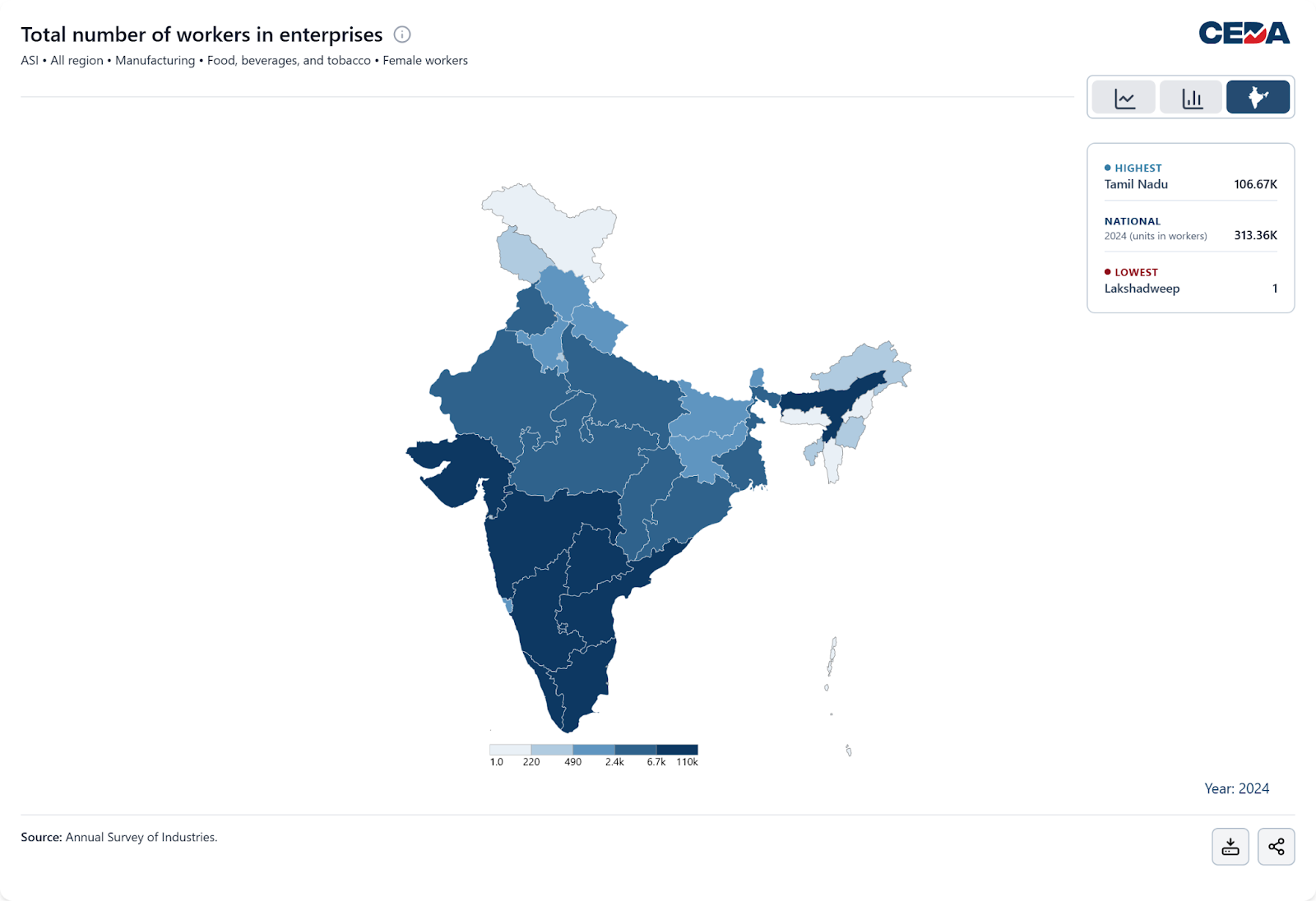
Women’s employment in India’s food, beverages, and tobacco manufacturing sector is highly concentrated in a handful of states, revealing a strikingly uneven geography of industrial work. Data from the Annual Survey of Industries, visualised through CEDA’s Economic Enterprise Trackers, shows that of the 313,360 women workers employed nationally in 2024, a substantial share is located in southern India. Tamil Nadu alone accounts for more than one-third of the workforce (106,670), followed by Andhra Pradesh (52,929) and Kerala (41,089). Together, these three states employ nearly two-thirds of all women workers in the sector, reflecting strong agro-processing value chains and labour markets that have historically integrated women into factory work. Beyond this southern cluster, the numbers taper off considerably. While Maharashtra and Karnataka also host sizable female workforces, most northern and eastern states (including Bihar, Haryana, and Rajasthan) record comparatively small numbers despite their population size. The geography of women’s employment in this sector, therefore, reflects not just labour supply but where food-processing industries have matured into stable factory-based production systems that integrate women into the manufacturing workforce.
CEDA’s Economic Enterprises Data Tracker brings India’s formal and informal enterprises into one unified view. Drawing on data from ASI, ASUSE, and earlier NSS rounds, the tracker standardizes key indicators on investment, productivity, credit, employment, and enterprise characteristics. Users can explore each survey on its own through standalone indicators, or directly compare trends across the formal and informal sectors using harmonised data. With interactive charts, state-level views, and downloadable datasets, the tracker offers a clearer, more complete picture of India’s enterprise economy for research, policy, and informed decision-making. Explore here.
⏳ Throwback

A ₹300 coffee becomes “free” because you walked instead of taking a cab. A dress on sale isn’t spending, it’s saving. Return something you bought last week, and suddenly you’ve made money. Welcome to the internet’s favourite new budgeting system: girl math.
The rules are simple. Bend the numbers. Rearrange the logic. Convince yourself that the purchase doesn’t really count. It’s funny because everyone recognises the trick. People everywhere perform these little mental gymnastics to justify spending. The arithmetic may be questionable, but the behaviour is universal.
So why call it girl math? Because the joke rests on a stereotype that refuses to die, that women are somehow irrational with money. For decades, culture has recycled the same lazy narrative: the shopaholic woman, the reckless credit card, the idea that women and numbers have a complicated relationship. Girl math simply gives that stereotype a shiny new meme format. And that’s where the sexism lies. The logic in these videos, convincing yourself that a purchase is justified, is hardly unique to women. Men do it all the time! A new phone becomes a long-term investment, a gaming console is framed as stress relief and a ₹20,000 bicycle is suddenly about fitness and productivity. No one calls that boy math. But attach the same logic to women, and it becomes a punchline about financial incompetence. The humour depends on the assumption that women’s reasoning with money is inherently ridiculous.
That assumption is old-fashioned misogyny dressed up as internet comedy. Because outside the meme economy, women are doing some of the most disciplined financial calculations there are. They manage household budgets, track spending, stretch incomes, and make difficult choices about how money gets allocated. If anything, the math women do every day is far more serious than the joke suggests. This makes the label feel less like humour and more like a familiar cultural reflex: take something ordinary women do and turn it into a joke about their supposed irrationality.
So yes, the meme is clever. The arithmetic is absurd. The videos are entertaining. But the name tells the real story- because the problem isn’t the math, it’s the ‘girl.’
📽️ Lights, Camera, Hustle: Women’s Work Lives in Movies

This fictional CV is a creative work inspired by the character Prabha from All We Imagine as Light (2024), with all names and references respectfully credited to the film’s original creators and rights holders.
Thank you for reading! If you have feedback, questions, tips, or just want to say hello, feel free to do so by replying to this email, or drop a word at editorial.ceda@ashoka.edu.in
For more updates and conversations, be sure to follow us on LinkedIn and X. We look forward to staying connected with you!
Curated by: Sneha Mariam Thomas for the Centre for Economic Data & Analysis (CEDA), Ashoka University. Cover illustration: Nithya Subramanian