

Women and Work- Forces Reshaping in May 2026
News, research and data about women and work - curated by our team

Hello, and welcome to CEDA’s newsletter ‘Women & Work’!

May arrives wrapped in the language of appreciation. Workers are celebrated for their resilience, and mothers for their sacrifice and their ability to hold everything together. But beneath these familiar tributes lies a deeper contradiction: the labour women perform, both paid and unpaid, sustains economies, workplaces, and households, yet remains persistently undervalued. Care is celebrated, but rarely redistributed. Resilience is praised, but often demanded in place of structural support. Women are expected to excel professionally while continuing to absorb the invisible responsibilities that keep homes and institutions functioning. At Women and Work, we move beyond symbolic recognition to examine the unequal structures shaping women’s economic realities. Applause fades quickly, but the burden of invisible labour remains long after the celebrations end.
Before we get started, a request: We are curating ‘Women & Work’ with the hope that it can provoke, stimulate and amplify conversations about women’s participation in paid work in India. If you like this edition, please do share it on your social media, and with your friends, family and colleagues. Thank you.
In case you would like to read any of our past editions, they are available here.

🗞️ In The News
In a recent commentary, Dr. Ashwini Deshpande, Academic Director of CEDA, reflects on how successive global shocks, from the COVID-19 pandemic to the ongoing West Asia conflict, have hit India’s informal workforce the hardest, with women bearing a disproportionate share of the burden. The piece underscores how women often absorb the deepest consequences of economic distress through loss of livelihoods, increased unpaid care work, disrupted access to healthcare, and growing household food insecurity. It calls for stronger social protection measures, portable welfare benefits for migrant workers, and predictable income support systems to better protect vulnerable women and families during future crises. Read more here.
LPG shortages linked to the West Asia crisis are forcing many low-income women in Delhi back to cooking on traditional chulhas, exposing them to extreme heat and hazardous smoke. India’s LPG consumption fell by 16% in April 2026 compared to the previous year, while commercial cylinder prices rose from ₹1,768 to over ₹3,000, sharply increasing cooking costs for small vendors and migrant households. Experts warn that the combined effects of heat stress and indoor air pollution pose serious health risks for women and children. Read more here.
Dr. Anisha Sharma, Associate Professor of Economics at Ashoka University, highlights how women’s unequal burden of unpaid work continues to restrict their participation in the labour market. Using findings from the 2024 Time Use Survey, the article notes that women aged 15-59 spend 341 minutes a day on unpaid domestic and caregiving work, compared to just 42 minutes spent by men, underscoring the scale of women’s ‘time poverty’ in India. Read more here.
Trigger Warning: Dowry violence, domestic abuse, death. The deaths of Twisha Sharma in Bhopal and Deepika Nagar in Greater Noida, both under suspicious circumstances shortly after marriage amid alleged dowry harassment, have reignited national outrage and renewed attention on India’s persistent dowry death crisis. The NCRB’s Crime in India, 2024, paints a grim picture: India recorded 5,737 dowry deaths, meaning nearly 16 women died every day, or roughly one every 90 minutes. The report also documented over 1.20 lakh cases of ‘cruelty by husbands and relatives,’ continuing a pattern that has remained above one lakh cases annually for more than a decade. Read more here.

💡 Research Spotlight
🛵 When mobility becomes an economic multiplier for women workers
For many women in India’s gig economy, the biggest barrier to earning more is not lack of work, skill, or ambition. It is simply getting from one job to another. Urban Company’s Project Udaan is a mobility intervention for women service professionals that combines riding training, licensing support, vehicle financing, and scooter ownership into an end-to-end programme designed to improve women’s workforce participation and earnings.
The project emerged from a striking paradox in Urban Company’s FY25 Earnings Index. Women service professionals earned ₹444.7 per hour compared to ₹322.4 for men, 38% more per hour, yet their monthly net earnings were nearly identical: ₹26,117 for women versus ₹26,547 for men. The gap was traced to mobility costs. Women without personal vehicles were spending nearly ₹7,000 every month on app-based autos and cabs between jobs, compressing the number of services they could complete and limiting access to high-demand time slots.
Why it matters
Women account for nearly one-third of all active service professionals on Urban Company’s platform. Research with Shreya Sarkar (UC Berkeley) and Women’s World Banking identified three barrier types: women who could ride but lacked a vehicle, women who owned a vehicle but could not ride, and women facing both constraints. The core finding: the missing enabler was not skill or intent, it was independent mobility.
About the project
The programme was implemented across Delhi NCR, Bengaluru, Pune, and Mumbai through a network of research, training, financing, and automobile partnerships, with approximately ₹3 crore invested to expand women’s access to independent mobility. The intervention followed a four-stage structure: training, licensing, financing, and ownership.
Training-Licensing: Women received a free 10-day riding curriculum (~₹10,000 per trainee value), with learner’s licence, documentation, and permanent licence support built in.
Financing: Loan products were tailored for first-time borrowers with simplified KYC and flexible repayment. Average EMI was ₹4,000 per month over a two-year tenure.
Ownership: A ₹10,000 down-payment subsidy and Original Equipment Manufacturers (OEMs)-discounted vehicles were provided. Urban Company bypassed traditional dealerships, where sales staff routinely directed conversations toward male family members rather than the woman buyer, by setting up dedicated women-focused two-wheeler camps across all four cities.
What changed?
Before scaling, Urban Company ran a six-month Randomised Controlled Trial (RCT) with 3,000 women across Delhi, Bengaluru, and Pune.
Weekly earnings increased by up to ₹1,175, while waiting time and travel expenditure reduced significantly. Analysis of April to October 2025 data showed a 14% increase in net monthly earnings for women who purchased scooters. These gains came from efficiency improvements such as faster travel between services, more bookings completed per day, and better access to higher-value time slots, rather than from longer working hours.
The strongest gains were recorded among first-time scooter owners, confirming that ownership, rather than riding ability alone, was the key constraint shaping women’s productivity and earnings. By December 2025, around 1,100 women had been trained, nearly 700 had purchased scooters, and approximately 1,800 women had participated in the programme in some capacity. The programme also disbursed nearly ₹50 lakh in down-payment subsidies.
Five-year cost modelling projected cumulative mobility expenditure of ₹3,97,845 for women without a two-wheeler, compared to ₹1,24,319 for scooter owners, net of a ₹40,000 asset value. However, ownership costs remained higher in the first two years because of EMI obligations, meaning the financial advantage materialised over the longer term.
Loan defaults across approximately 700 first-time borrowers stood at zero, directly challenging assumptions that women gig workers are high-risk borrowers. For many participants, this was also their first formal credit interaction, helping build repayment histories and improving access to future borrowing opportunities.
Way forward
The report proposes a six-point national blueprint centred on women’s mobility and workforce participation. Recommendations include public-private mobility training hubs, simplified digital-first licensing systems, women-friendly dealership environments, and gender-responsive vehicle design better suited to average Indian women’s height and ergonomics. It also calls for alternative credit assessment mechanisms such as psychometric scoring and simplified KYC for gig workers, alongside a coordinated national mobility mission that links digital public infrastructure with large-scale subsidy access.
Read more about Project Udaan here.
📊 Datapoint
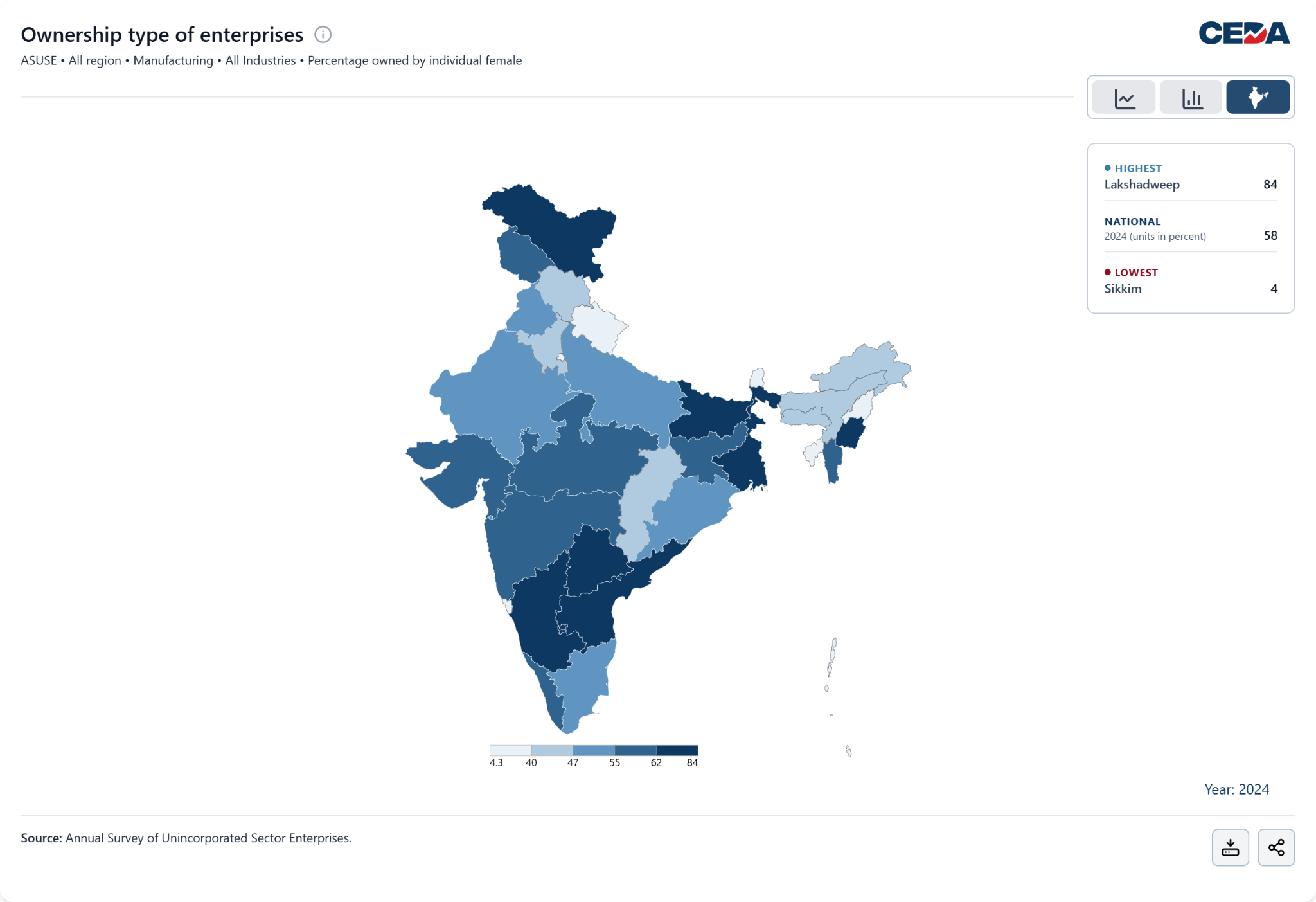
State-wise share of women-owned enterprises in the informal manufacturing sector across all regions (rural + urban) in 2024
💡 Bonus Insight
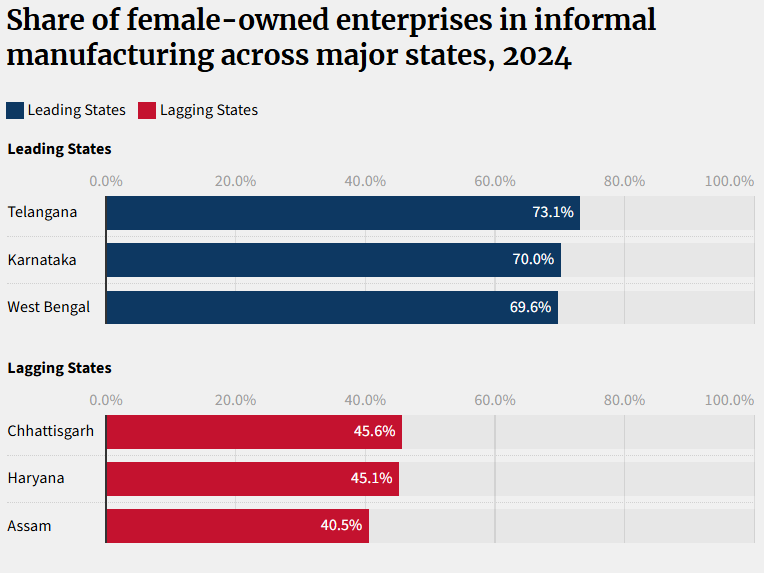
Women are at the heart of India’s informal manufacturing economy. This map, based on Annual Survey of Unincorporated Sector Enterprises (ASUSE) data visualised on CEDA’s Economic Enterprise Tracker, captures the share of informal manufacturing enterprises owned by women across states and union territories in 2024. Nationally, women own nearly 6 in 10 informal manufacturing enterprises (58.4%), making women-led ownership a defining feature of the sector. The momentum is especially striking in states such as Manipur, where women own more than three-fourths of manufacturing enterprises (77.7%), followed by Telangana (73.1%) and Karnataka (70%). At the other end, Delhi (20%) and Sikkim (4.3%) report some of the lowest levels of women-owned enterprises, highlighting stark regional disparities in patterns of enterprise ownership across the country.
CEDA has launched Economic Enterprises Data Tracker, a new tool that brings India’s formal and informal enterprises into a single, comparable view. Drawing on ASI, ASUSE, and earlier NSS rounds, it standardises key indicators on investment, productivity, credit, employment, and enterprise characteristics. Users can explore each survey separately or compare trends across sectors using harmonised data. With interactive charts, state-level insights, and downloadable datasets, the tracker provides a clearer, consolidated view of India’s enterprise economy for research and policy use.
⏳ Throwback
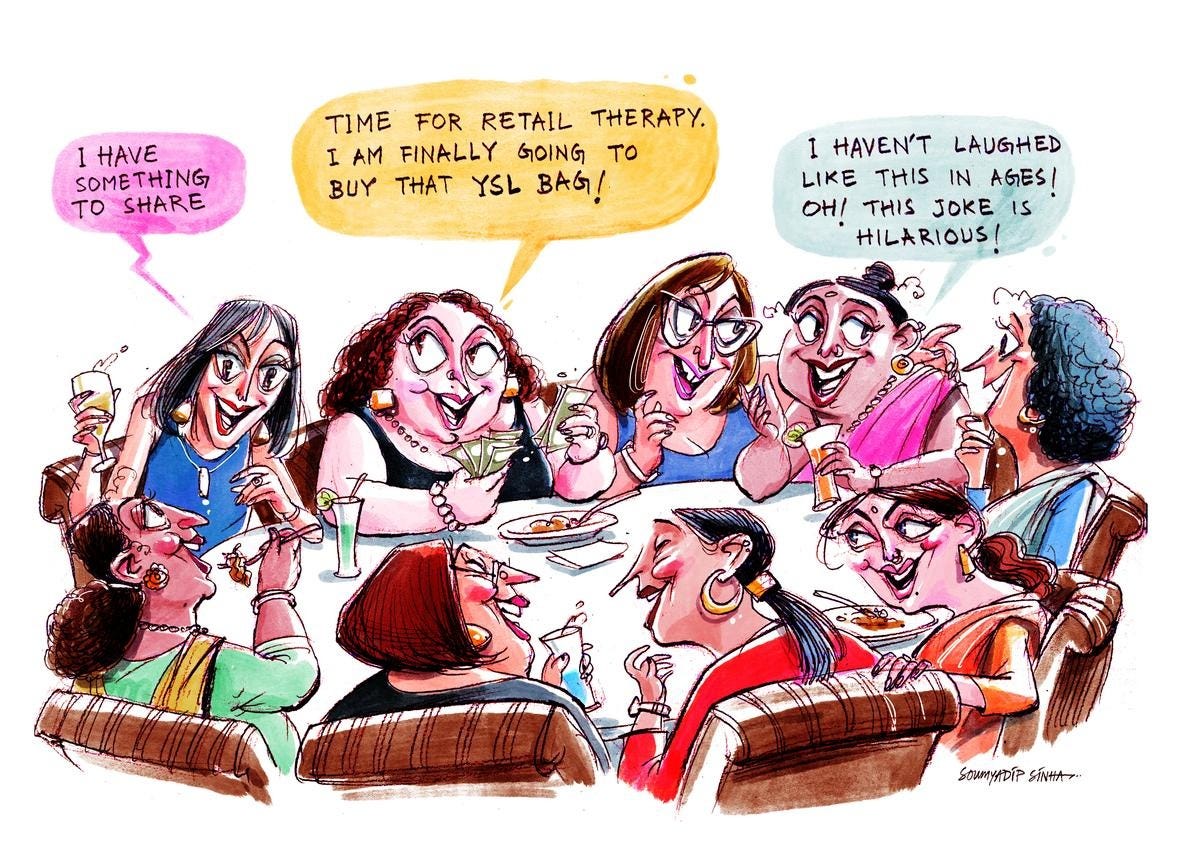
Inspired by recent reflections from comedian and content creator Mallika Dua, it may be time to revisit one of India’s most underestimated social institutions: the kitty party. For decades, the ‘kitty party’ has occupied a curious place in India’s social imagination, often dismissed as frivolous gatherings of women exchanging gossip over snacks and cards. Popular culture has frequently reduced them to symbols of excess, idleness, or superficiality. But beneath the stereotypes lies a far more important story: kitty parties have long functioned as informal financial and social institutions for millions of Indian women.
At their core, kitty parties are built around a rotating savings system. Each member contributes a fixed amount regularly, and one participant receives the pooled sum during every cycle. In practice, this creates an accessible, trust-based financial network, especially for women who may have limited access to formal banking, credit, or independent income. Long before ‘financial inclusion’ became a policy buzzword, women across urban neighbourhoods and small towns were already building their own systems of savings, liquidity, and mutual support through these collectives. But their significance extends beyond money. Kitty parties have historically created rare social spaces where women could build networks outside the household, exchange information, discuss family finances, explore small business opportunities, and develop confidence in public interaction. For many homemakers, particularly in earlier decades, these gatherings offered both emotional solidarity and a degree of economic agency within otherwise restrictive social structures. Their influence can also be seen in the rise of women-led micro-enterprises and informal entrepreneurship. From home-based catering and tailoring businesses to beauty services and retail ventures, many women have used kitty networks to access customers, informal credit, and word-of-mouth marketing. In this sense, kitty parties have quietly operated as grassroots economic ecosystems.
Today, as conversations around women’s entrepreneurship, self-help groups, and financial inclusion gain prominence, the kitty party deserves a reappraisal. What was once mocked as an unserious pastime can also be understood as a deeply local form of community finance, social capital, and women-led economic participation. Far from being trivial, kitty parties reveal how women have historically created support systems and financial resilience within the constraints of everyday life.
📽️ Lights, Camera, Hustle: Women’s Work Lives in Movies
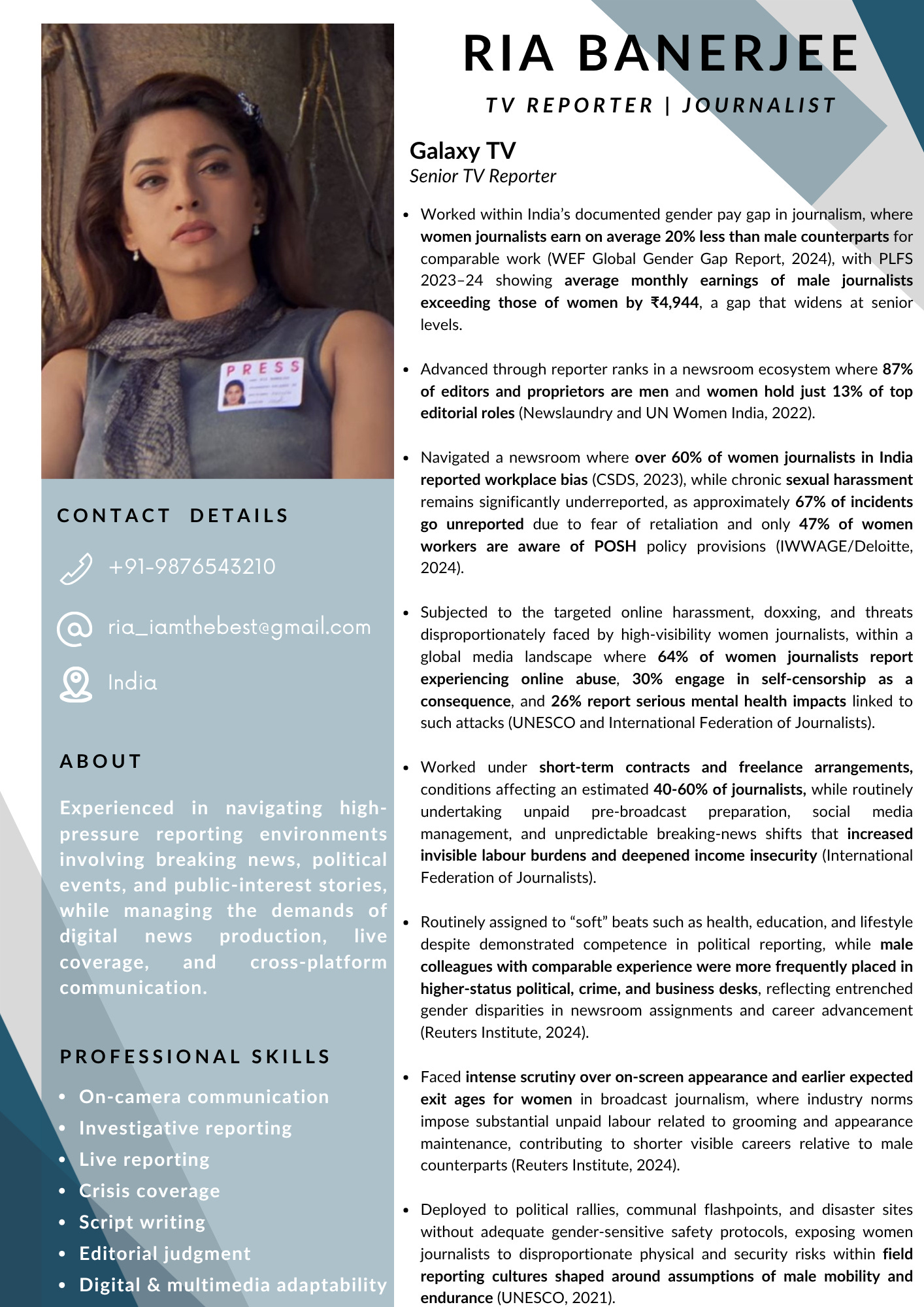
This fictional CV is a creative work inspired by the character Ria Banerjee from Phir Bhi Dil Hai Hindustani (2000), with all names and references respectfully credited to the film’s original creators and rights holders.
Thank you for reading! If you have feedback, questions, tips, or just want to say hello, feel free to do so by replying to this email, or drop a word at editorial.ceda@ashoka.edu.in
For more updates and conversations, be sure to follow us on LinkedIn and X. We look forward to staying connected with you!
Curated by: Sneha Mariam Thomas for the Centre for Economic Data & Analysis (CEDA), Ashoka University. Cover illustration: Nithya Subramanian
A lot of inequality isn't created through one large barrier. It's created through small frictions that accumulate over time until they become different career trajectories.