


Hello, and welcome to CEDA’s newsletter ‘Women & Work’!

The festive season is in full swing, at the halfway mark, or yet to kick off, depending on where you are. While some are deep into the celebrations, others are just getting started. Amid the lights, sweets and reunions, though, the world of work carries on. Women continue to negotiate poor pay, navigate unequal opportunities and shoulder responsibilities that rarely pause for a festival. Behind the festive cheer lie harder questions about who gets to thrive, whose labour goes unseen, and what it takes to make opportunity more equal. Because while celebrations may bring people together, the realities of work and inequality remind us how differently women experience the world around them.
Before we get started, a request: We are curating ‘Women & Work’ with the hope that it can provoke, stimulate and amplify conversations about women’s participation in paid work in India. If you like this edition, please do share it on your social media, and with your friends, family and colleagues. Thank you.
In case you would like to read any of our past editions, they are available here.

🗞️ In The News
The ILO’s new convention on platform work promises better protections for workers, but does it account for gendered realities? From the omission of explicit protections against sexual harassment to gaps in social security, the framework leaves critical questions unanswered for women and marginalised workers. Read how gender, caste and other inequalities expose the limits of a one-size-fits-all approach to platform work.
When a survivor speaks up, what happens if the systems meant to deliver justice fall short? A woman’s allegations of rape by members of a Cornell University fraternity in 2024 have resurfaced, prompting scrutiny of the university’s disciplinary actions and the handling of evidence by prosecutors. New York’s attorney general has now taken over the reopened investigation, renewing questions about accountability and how sexual assault allegations are heard and pursued. Read more here.
As AI reshapes the future of work, women risk being left out of its most lucrative opportunities while remaining more exposed to automation. Citing LinkedIn research, the article notes that women account for just 25% of new AI hires and 13% of executive roles, while men earn $45,000 more in median pay across AI occupations. Unequal access to leadership, established hiring networks and workplace support could deepen gender inequality in the very industry shaping the global economy.
The Outlook-Toluna Survey of 1,334 women found that 44% of married women delaying motherhood cite work-life balance as a key concern, while 34% believe motherhood negatively affects women’s career progression. The piece examines how unequal caregiving responsibilities, inadequate childcare and inflexible workplaces contribute to the motherhood penalty, highlighting the need for stronger support systems to help women balance careers and parenthood. Read more here.

💡 Research Spotlight
Women run the morning. The morning runs them down.
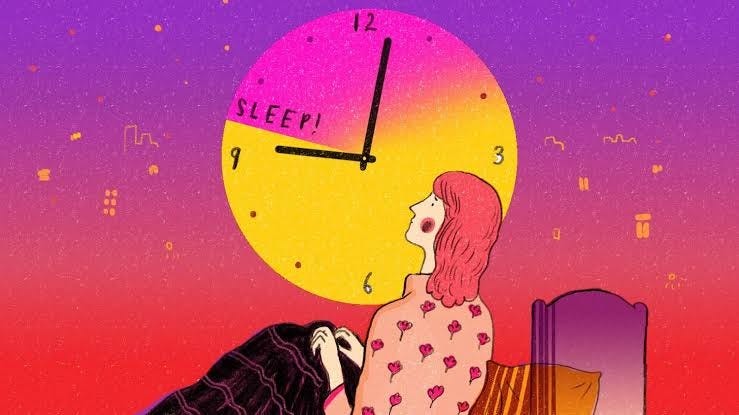
The alarm rings, but not for everyone. In many Indian households, women are up first, getting the family ready for the day, and are often the last to sit down to eat. In this everyday choreography, whose time comes first, and whose can be put aside?
In First to Wake-Up, Last to Eat: Evidence of Disproportionate Morning Penalties on Women in India, published in the Journal of Development Studies, Udayan Rathore examines how gender inequality unfolds across the day. Rather than treating mealtime order as a single household practice, the study distinguishes between morning and night to investigate when women bear the greatest disadvantage, and what it costs them.
Following the clock
The study uses India’s Time Use Survey (TUS) 2019, which records how people spend a 24-hour day in 30-minute intervals. The analysis covers 286,233 individuals aged 18-59 across 112,974 households, comparing who wakes first, who eats the morning and night meals last, who sleeps first, and how long people wait between waking and their first meal.
Regression models account for differences in employment, education, caste, household consumption, family structure, children and other characteristics. Additional tests examine whether work schedules and time flexibility explain the gaps, and how these vary with measures of patriarchal norms.
What the clock reveals
Women wake at 5:44 am on average, 26 minutes before men. Yet their first meal comes at 9:40 am, also 26 minutes later than men’s.
Nearly 72% of women are the first to wake, compared with 36% of men. Women are also more likely to eat the morning meal last: 55%, against 36% of men. At night, the gender gap in eating last narrows to just three percentage points.
After accounting for individual and household characteristics, women remain 31.4 percentage points more likely to wake first and 14.8 percentage points more likely to eat the morning meal last. They also wait 42 minutes longer after waking before their first meal.
Women who wake first sleep around 40 minutes less and spend approximately 90 additional minutes on domestic chores and care work than other women.
Women who are last in the household to have their first meal of the day are 15.6 percentage points more likely than other women to skip breakfast, so for them the first meal may be lunch rather than a late breakfast.
Paid work does not erase the penalty. When both partners are in paid employment, women are around 42 percentage points more likely than men to wake first. Accounting for time spent on employment and food preparation reduces the estimated gaps, but women remain 18.5 percentage points more likely to wake first and 4.7 percentage points more likely to eat the morning meal last.
Household position and social norms matter. Morning mealtime penalties are generally smaller among Scheduled Tribe women than among women from other caste groups, which the study links to more equal gender norms in these communities. Within joint families, daughters-in-law face a greater burden than mothers-in-law. Households with children, particularly preschool-aged children, also show larger penalties on some measures.
Who gets the first claim on a woman’s day?
The study cannot establish direct health effects, as the TUS does not collect health outcomes. But its findings reveal the organisation of household time where women get less sleep, skip meals more often, and carry heavier care workloads, all relevant to women’s well-being. Rathore points to reliable electricity, labour-saving technologies, accessible childcare and eldercare, and education that challenges gendered ideas about domestic work. The goal is not simply to make women’s mornings more efficient. It is to reduce the unpaid work that makes their early start seem inevitable.
The inequality is visible before the working day for the rest of the household begins: women give more time to the household, and have less time left for themselves. A fairer division of work must begin at home, with a different answer to a basic question: who gets to start their day on their own terms?
📊 Datapoint
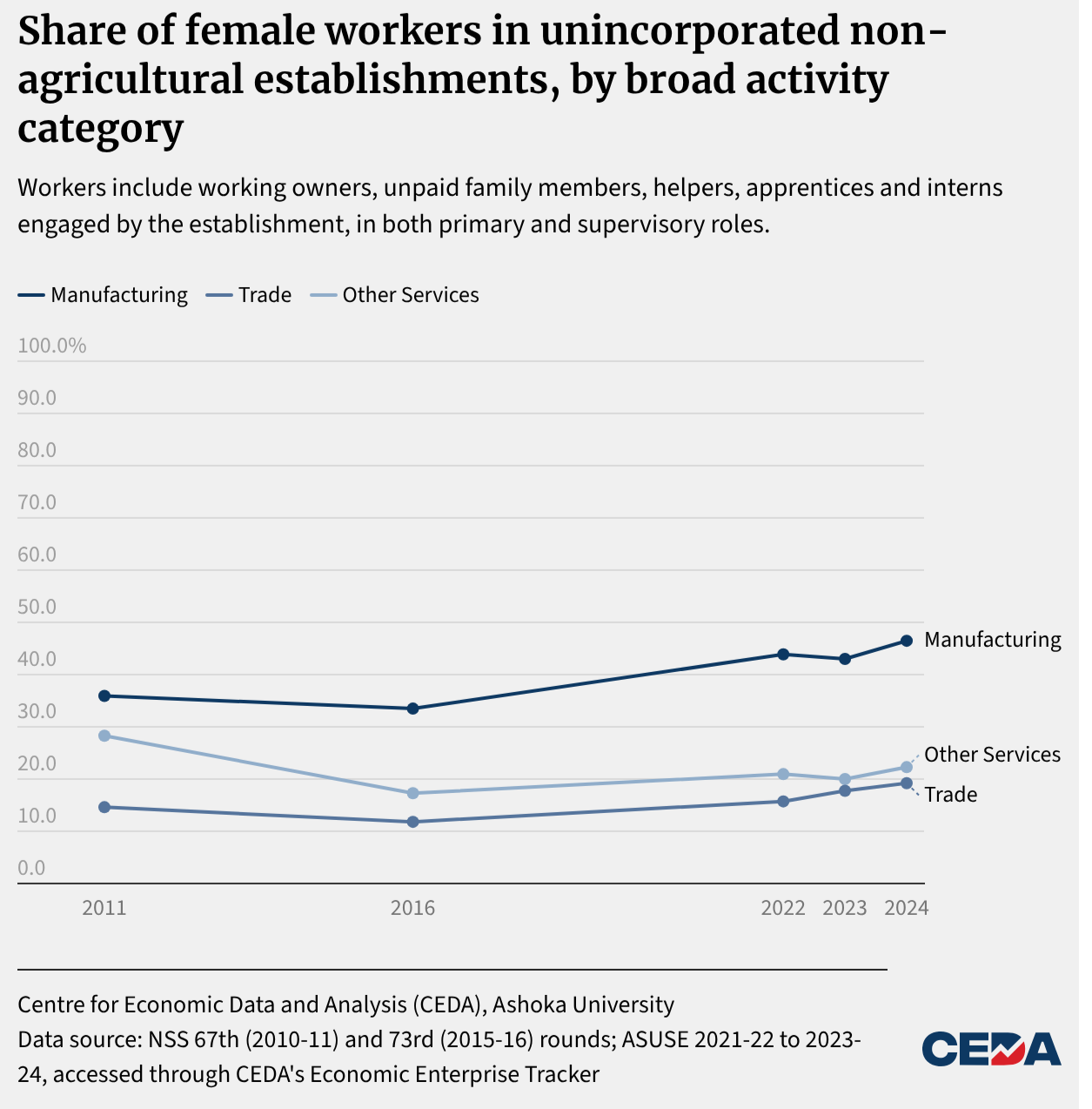
Women’s representation across broad activity categories in the informal economy outside agriculture and excluding construction has evolved unevenly. Manufacturing recorded the highest share of female workers across all survey years, rising from 35.9 per cent in 2011 to 46.5 per cent in 2024. This 10.6 percentage-point increase brought women close to accounting for half of the workforce in informal manufacturing. Trade recorded a more modest increase of 4.6 percentage points to 19.2 per cent over the same period, while other services was the only category where the female share remained below its 2011 level, falling by 6 percentage points to 22.3 per cent in 2024.
Read Sneha Mariam Thomas’s analysis to explore how women’s informal work outside agriculture has changed over time, how the rural-urban composition of female workers has evolved within each broad activity, and the industries that account for much of their employment today.
⏳ Throwback
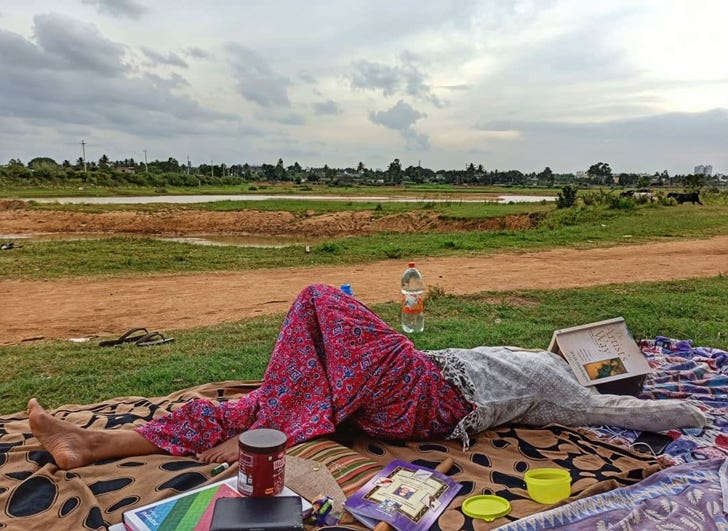
Festival season is approaching, bringing with it the familiar checklist: homes to clean, sweets to prepare, clothes to buy, guests to host and celebrations to organise. The calendar fills up, the to-do list grows, and somewhere between the shopping and the preparations, a simple question gets lost: who has the time to enjoy the festival?
Women’s work is often discussed through two familiar lenses: paid employment and unpaid domestic and care work. We ask whether women have jobs, how much they earn, and how household responsibilities shape their lives. But there is another dimension to this conversation that deserves attention: time poverty. Time poverty is what happens when the demands of paid work, household chores and caregiving leave people with too little time for rest, recreation, personal interests or social connections. It is not simply about having a packed schedule. It is about having so little control over one’s time that even rest becomes difficult to claim.
For many women, leisure is conditional. First, the cooking must be done. The house must be in order. The children must be looked after. Guests must be attended to. Only when the list is complete can a woman consider taking a break. Except that the list rarely ends. There is always another meal, another chore, another person who needs something. And festivals can make this imbalance especially visible. While celebrations are framed as occasions for family, togetherness and enjoyment, the work that makes them possible is not always shared equally. One person may experience the festival as a holiday; another may spend it preparing, serving, cleaning and ensuring everyone else has a good time. The celebration is collective. The labour behind it may not be.
This is why leisure matters in conversations about gender equality. Free time is not an indulgence or a bonus that women can claim once they have fulfilled every responsibility. It is part of having control over one’s life: the freedom to rest without guilt, pursue an interest without interruption, meet a friend without negotiating every minute, or simply do nothing without being reminded of everything left undone.
What does leisure look like when your time is rarely your own? Check out Women at Leisure, an Instagram page that brings women’s leisure into focus. By making space for conversations about how women spend, experience and access their free time, it challenges the assumption that leisure is trivial compared with work. It asks us to look not only at the labour women perform, but also at the time they have left once that labour is done.
The question is particularly relevant as the festive season approaches. Who gets to put their feet up? Who gets to participate without organising every detail? And whose idea of a holiday is simply a day of doing the same work in better clothes?
Equality is not just about sharing the workload. It is also about sharing the right to switch off.
📽️ Lights, Camera, Hustle: Women’s Work Lives in Movies
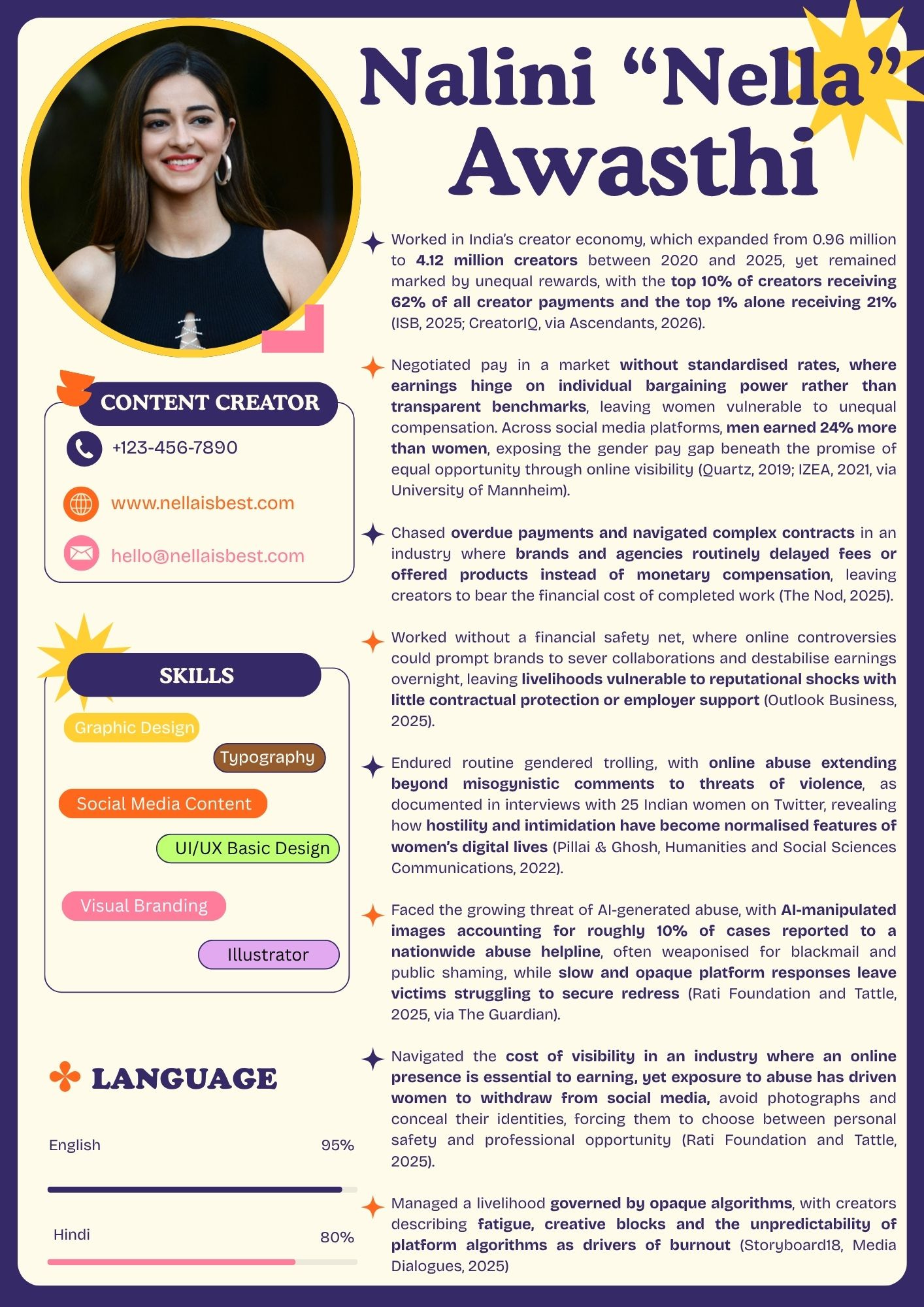
This fictional CV is a creative work inspired by the character Nalini “Nella” Awasthi from the film CTRL (2024), with all names and references respectfully credited to the film’s original creators and rights holders.
Thank you for reading! If you have feedback, questions, tips, or just want to say hello, feel free to do so by replying to this email, or drop a word at editorial.ceda@ashoka.edu.in
For more updates and conversations, be sure to follow us on LinkedIn and X. We look forward to staying connected with you!
Curated by: Sneha Mariam Thomas for the Centre for Economic Data & Analysis (CEDA), Ashoka University. Cover illustration: Nithya Subramanian