


Hello, and welcome to CEDA’s newsletter ‘Women & Work’!

Every month leaves behind a few questions worth carrying forward. September is no different. As the year gathers pace, we look at the moments, movements and changes shaping women’s lives at work and beyond, following the stories that deserve a closer look and the numbers that make them harder to ignore.
Before we get started, a request: We are curating ‘Women & Work’ with the hope that it can provoke, stimulate and amplify conversations about women’s participation in paid work in India. If you like this edition, please do share it on your social media, and with your friends, family and colleagues. Thank you.
In case you would like to read any of our past editions, they are available here.

🗞️ In The News
A seemingly striking story of gender success in India’s informal manufacturing sector looks very different beneath the headline numbers. In their article for CNBC-TV18, Dr. Kanika Mahajan, Associate Professor of Economics at Ashoka University and member of CEDA’s advisory group, and Sneha Mariam Thomas, draw on ASUSE 2023-24 data to examine what women’s 58.4% ownership share actually represents. The analysis shows that women’s enterprises remain concentrated in small, home-based and low-capital activities, raising broader questions about their ability to scale and participate across the wider manufacturing economy.
The world is inching towards gender parity, but the finish line remains 120 years away at the current pace. The World Economic Forum’s Global Gender Gap Report 2026 finds 69.2% of the global gap closed, while India ranks 131st of 145 economies, unchanged from last year and behind Bangladesh (79th), Nepal (120th) and Bhutan (121st). India’s numbers tell a sharper story: education is close to parity at 96.6%, including full parity in secondary and tertiary enrolment. But this progress does not carry through to economic participation, where India scores just 41.2%, with labour-force participation parity at 44.1%. Political empowerment trails further behind at 24.5%, with parity scores of just 16.1% in parliament and 5.9% at the ministerial level.
The Eiffel Tower was briefly brought to a standstill after staff protested a decision to keep female employees out of sight during a religious delegation’s visit. Management later apologised and launched an inquiry, raising a familiar question about who gets to belong, and be visible, in the workplace. Read more here.
From a legal battle to a livelihood of their own, three nuns are stitching together a path towards financial independence. One of them accused former Jalandhar Bishop Franco Mulakkal of rape, while the other two stood by her through the legal battle. They say the support they once received from their congregation eventually stopped, prompting them to build a new source of livelihood. Through their recently launched initiative, Stand By Me, the three now make clothes and bags to support themselves. Meanwhile, the survivor’s appeal against Mulakkal’s acquittal remains pending before the Kerala High Court. Read about the case and initiative.

💡 Research Spotlight
A health condition does not always stay at home when a woman goes to work. For women living with polycystic ovary syndrome (PCOS), its effects can extend from symptoms and doctor visits to missed days, disrupted work and even how far a career can progress. A 2024 study in F&S Reports puts numbers to this less visible cost, asking a simple but overlooked question: what happens to women’s working lives when they live with PCOS?
What did the researchers look at?
The study goes beyond absenteeism. It examines four ways PCOS may shape working lives: missing work, taking extended leave, experiencing a decline in the quality of work, and feeling held back in a career. It also asks a second, more revealing question: who experiences these consequences more strongly? The researchers examine whether race, education, insurance coverage, access to and satisfaction with healthcare, anxiety and depression are associated with these workplace outcomes.
How was the study conducted?
The researchers conducted an internet-based, cross-sectional survey between August and October 2022. Participants were recruited through social media and PCOS virtual-care waitlists and were North American women with a self-reported physician diagnosis. The survey received 1,105 responses. Of these, 1,058 respondents with a physician-given diagnosis formed the main analytical sample, while 1,022 respondents with complete predictor information were included in the multivariate models. The participants had a mean age of 30.6 years and ranged from 15 to 57.
To measure workplace impact, respondents answered four yes-or-no questions covering missed work, extended leave, work quality and career progression. Anxiety and depression were assessed using the GAD-7 and PHQ scales, standardised screening tools used to measure symptoms of anxiety and depression, respectively. The researchers first used univariate logistic regression to identify associations between individual factors and each outcome, followed by multivariate logistic regression to examine significant predictors while accounting for other variables.
What happened at work?
The findings suggest that the impact of PCOS does not stop at the office door.
For 50.4% of respondents, it had meant missing work at some point. But the larger story was what happened even when women were able to show up. Nearly three-quarters (72%) said PCOS had affected the quality of their work, making work itself part of the burden. And for 51.5%, the impact reached further still: they reported feeling held back in their careers because of the condition.
The study also shows that this burden was not experienced uniformly. After adjustment, Black respondents had 1.67 times the odds of missing work compared with White respondents. The difference was even larger when it came to extended leave: their odds of needing it were 2.54 times higher.
Mental health was closely intertwined with these workplace experiences. Respondents with anxiety had 2.13 times the odds of needing extended leave, while those with depressive symptoms had 2.47 times the odds of feeling held back in their careers. Depression was also associated with more than twice the odds of reporting an impact on work quality.
And sometimes, the difficulty began long before a woman reached the workplace. Women who needed multiple doctors to obtain a diagnosis or three or more providers for ongoing care were more likely to report adverse work outcomes. Those who needed at least three doctors for diagnosis had 1.83 times the odds of feeling held back in their careers.
Limitations
The findings, however, come with important limitations. The sample was recruited through social media and PCOS virtual-care waitlists and may therefore include a higher share of women experiencing more severe or bothersome symptoms. The cross-sectional design identifies associations rather than causation, the outcomes were self-reported, and the four work-related questions were adapted from an endometriosis study rather than separately validated for PCOS.
Why does this matter?
In 2026, PCOS was renamed Polyendocrine Metabolic Ovarian Syndrome (PMOS), reflecting a growing recognition that the condition reaches far beyond the ovaries, with endocrine, metabolic, reproductive and mental-health consequences. The renaming followed years of advocacy and debate, underscoring how long it has taken for the full scope of women’s health to receive attention. That neglect is also visible in the world of work. PCOS has affected women for decades, yet its consequences for their working lives have remained largely overlooked. Among the first studies to specifically examine PCOS and employment outcomes, this research brings that missing dimension into focus, showing that its effects can extend beyond whether a woman has a job to absences, longer periods away from work, difficulties sustaining performance and disruptions to career progression.
It is a reminder that when women’s health is sidelined, the consequences do not remain confined to healthcare. They can follow women into the workplace, shaping not just whether they work, but how securely they work, perform and progress.
📊 Datapoint
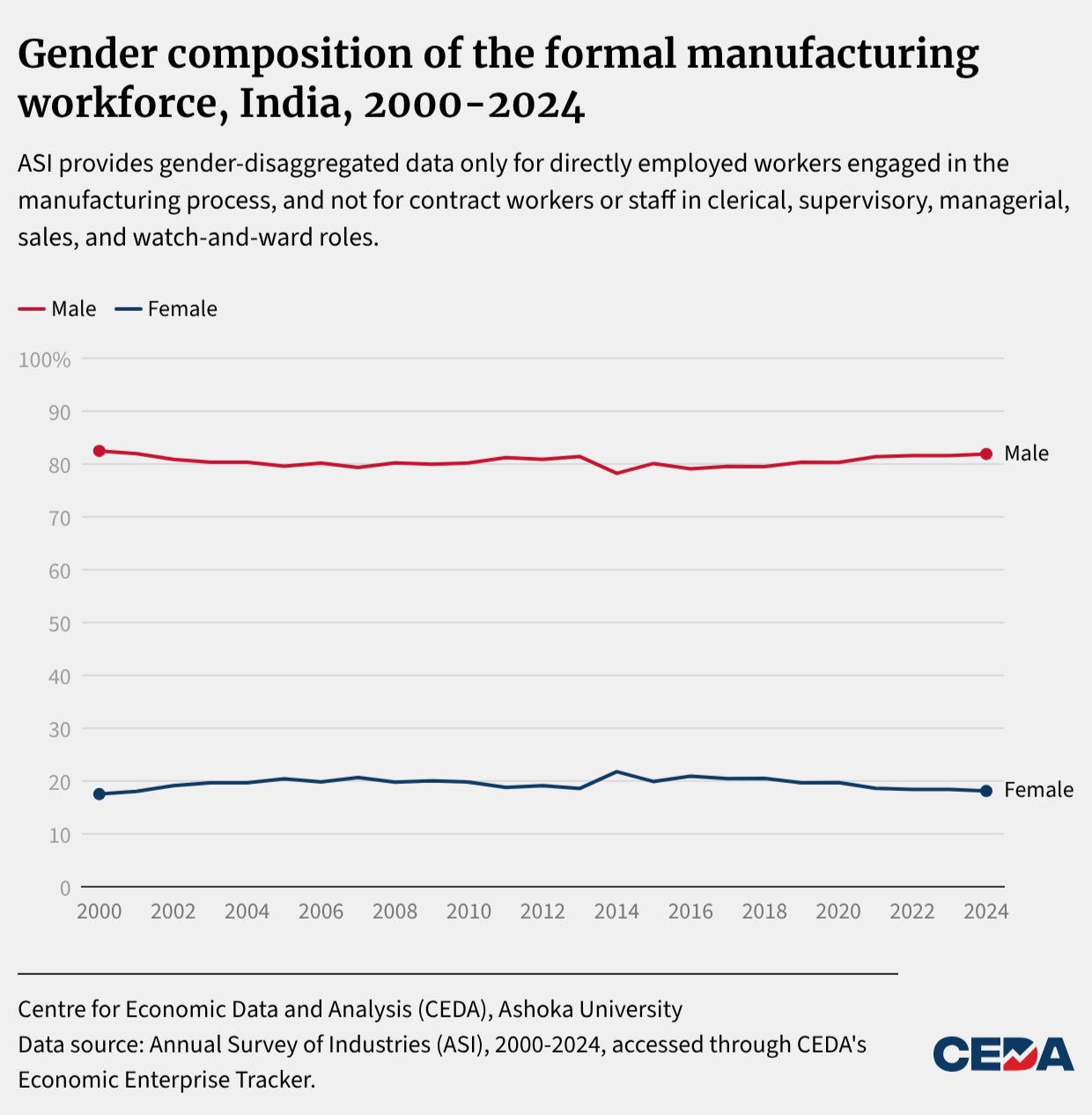
Manufacturing is often seen as a key engine of India’s industrial growth, but where are women in this workforce? Over the past two decades, their presence in formal manufacturing has remained remarkably limited. Women’s share of directly employed workers rose from 17.5% in 2000 to a high of 21.8% in 2014, but the gains did not last. By 2024, women accounted for just 18.1% of the workforce, or roughly one woman for every 4.5 men.
So, what does women’s presence in India’s formal manufacturing sector look like beneath this national picture? Read the full analysis by Sneha Thomas to explore how women’s representation in formal manufacturing has evolved across states and industries, and what this reveals about the changing landscape of women’s employment.
⏳ Throwback
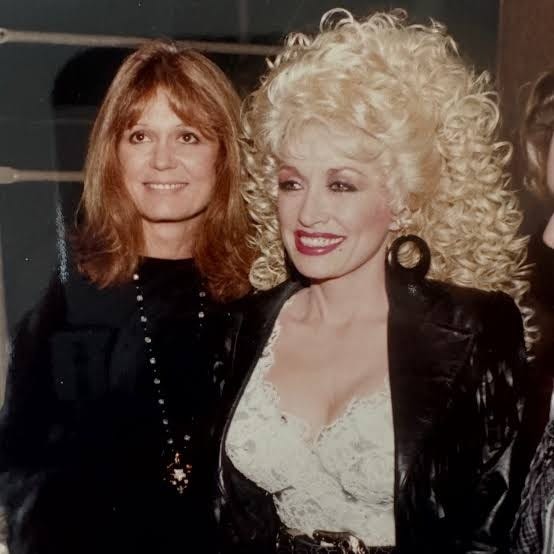
Sometimes, a throwback is more than a look back. It is a little moment to say thank you.
Some women change the world by standing at a podium. Others do it with a guitar in hand. In the past two months, we lost two women who seemed almost larger than life: Gloria Steinem and Dolly Parton. They came from entirely different worlds, but both understood something fundamental about women and work: sometimes, changing the world begins with refusing to accept the space you have been given.
Steinem spent her life asking why that space was so small in the first place. As a journalist, writer and organiser, she brought the private realities of women’s lives into public view, from discrimination at work and unequal pay to reproductive rights and violence. She co-founded Ms. magazine, helped build organisations that carried the women’s movement forward, and became a voice for generations of women who were learning to name the inequalities they had always felt but had not always had the words for. Her famous line, “The truth will set you free, but first it will piss you off,” captures something of her spirit: she was never particularly interested in making uncomfortable truths comfortable.
And then there was Dolly. If Steinem arrived with a question, Parton arrived with a song. 9 to 5 gave working women an anthem for the frustrations of the workplace, but Parton’s own working life was an even bigger story. She built an extraordinary career as a songwriter, performer, actor and entrepreneur, while turning her success into something much larger than herself. From Dollywood to her Imagination Library, which has put millions of books into children’s hands, she had a particular talent for turning what she had into what someone else needed.
Steinem gave women language. Parton gave them songs. Both left behind institutions, ideas and possibilities that will outlive them. And so, we remember them not simply for what they achieved, but for the women who could achieve a little more because Gloria Steinem and Dolly Parton had gone before them.
Two stalwarts. Two extraordinary lives. Two very different ways of making the world bigger.
What a gift to have had them. What a responsibility to carry the work forward.
📽️ Lights, Camera, Hustle: Women’s Work Lives in Movies
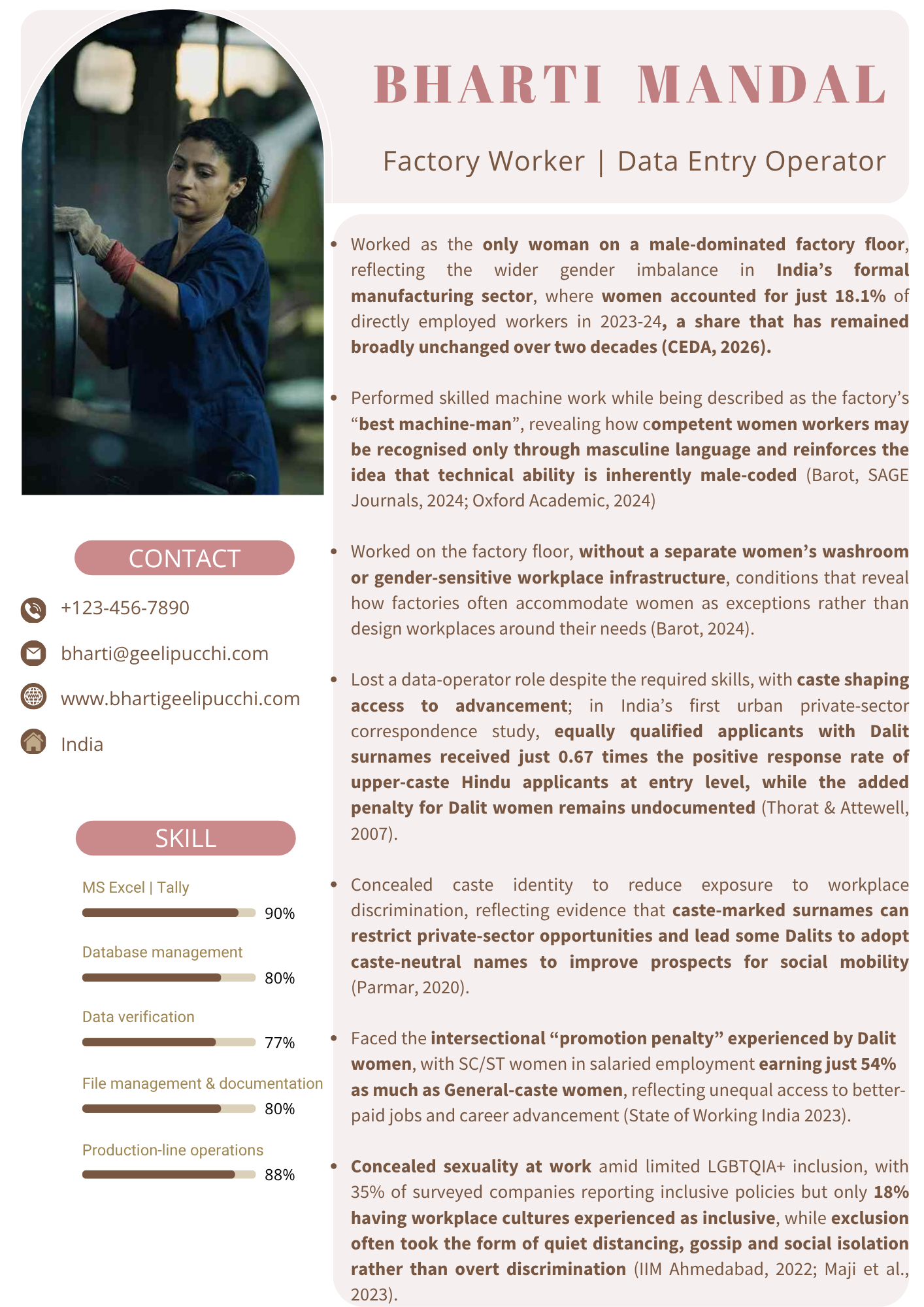
This fictional CV is a creative work inspired by the character Bharti Mandal from Geeli Pucchi, part of the 2021 anthology film Ajeeb Daastaans. All names and references are respectfully credited to the film’s original creators and rights holders.
Thank you for reading! If you have feedback, questions, tips, or just want to say hello, feel free to do so by replying to this email, or drop a word at editorial.ceda@ashoka.edu.in
For more updates and conversations, be sure to follow us on LinkedIn and X. We look forward to staying connected with you!
Curated by: Sneha Mariam Thomas for the Centre for Economic Data & Analysis (CEDA), Ashoka University. Cover illustration: Nithya Subramanian